A proposed nomenclature for quartal harmony
Quartal chords are chords built by stacking fourths on top of one another, just like chords in tonal music are built by stacking thirds. We will use the square □ and triangle △ symbols to symbolise each type of chord, respectively. We will proceed analogising the system of chord naming used for △-chords.
Fourths can be of different species. The ordinary species are perfect (or just) and augmented (a tritone). The fourth can also be diminished (this interval is enharmonic with a major third).
We will currently focus only on quartal chords made from perfect and augmented fourths (diminished fourths will be included on a future version of this article).
There are diatonic (following the so-called greek modes) and chromatic quartal chords. One of our approaches (the jazzier one) will name quartal chords by the mode in which they appear as the tonic-quartal-chord (and indicating alterations from the mode by accidentals).
The other approach will name them indicating where are the tritones located using a subscript.
To indicate the amount of notes in a chord, we will use a superscript. If the chord is a quartal triad, the superscript can be omitted.
Here is the table of chords composed only of tritones and perfect fourths. P stands for perfect fourth and T for tritone.
| Intervals | Jazzy cypher | Tritone cypher |
|---|---|---|
| PP | □J | □³ |
| PT | □Ion | □³ ₃ |
| TP | □Lyd | □³ ₂ |
| PPP | □⁴J | □⁴J |
| PPT | □⁴Mix | □⁴ ₄ |
| PTP | □⁴Ion | □⁴ ₃ |
| TPP | □⁴Lyd | □⁴ ₂ |
| TPT | □⁴m-Lyd | □⁴ ₂,₄ |
| PPPP | □⁵J | □⁵ |
| PPPT | □⁵Dor | □⁵ ₅ |
| PPTP | □⁵Mix | □⁵ ₄ |
| PTPP | □⁵Ion | □⁵ ₃ |
| PTPT | □⁵m-Ion | □⁵ ₃,₅ |
| TPPP | □⁵Lyd | □⁵ ₂ |
| TPPT | □⁵Lyd♯6 | □⁵ ₂,₅ |
| TPTP | □⁵m-Lyd | □⁵ ₂,₄ |
| PPPPP | □⁶J | □⁶ |
| PPPPT | □⁶Eol | □⁶ ₆ |
| PPPTP | □⁶Dor | □⁶ ₅ |
| PPTPP | □⁶Mix | □⁶ ₄ |
| PPTPT | □⁶Mix♯9 | □⁶ ₄,₆ |
| PTPPP | □⁶Ion | □⁶ ₃ |
| PTPPT | □⁶Ion♯9 | □⁶ ₃,₆ |
| PTPTP | □⁶m-Ion | □⁶ ₃,₅ |
| TPPPP | □⁶Lyd | □⁶ ₂ |
| TPPPT | □⁶Lyd♯9 | □⁶ ₂,₆ |
| TPPTP | □⁶Lyd♯6 | □⁶ ₂,₅ |
| TPTPP | □⁶m-Lyd_nat | □⁶ ₂,₄ |
| TPTPT | □⁶m-Lyd | □⁶ ₂,₄,₆ |
| PPPPPP | □⁷J (Locr) | □⁷ |
| PPPPPT | □⁷Phr | □⁷ ₇ |
| PPPPTP | □⁷Eol | □⁷ ₆ |
| PPPTPP | □⁷Dor | □⁷ ₅ |
| PPPTPT | □⁷Dor♯5 | □⁷ ₅,₇ |
| PPTPPP | □⁷Mix | □⁷ ₄ |
| PPTPPT | □⁷Mix♯5 | □⁷ ₄,₇ |
| PPTPTP | □⁷Mix♯9 | □⁷ ₄,₆ |
| PTPPPP | □⁷Ion | □⁷ ₃ |
| PTPPPT | □⁷Ion♯5 | □⁷ ₃,₇ |
| PTPPTP | □⁷Ion♯9 | □⁷ ₃,₆ |
| PTPTPP | □⁷Ion♯6 / m-Ion♮5 | □⁷ ₃,₅ |
| PTPTPT | □⁷m-Ion | □⁷ ₃,₅,₇ |
| TPPPPP | □⁷Lyd | □⁷ ₂ |
| TPPPPT | □⁷Lyd♯5 | □⁷ ₂,₇ |
| TPPPTP | □⁷Lyd♯9 | □⁷ ₂,₆ |
| TPPTPP | □⁷Lyd♯6 | □⁷ ₂,₅ |
| TPPTPT | □⁷Lyd♯6♯5 | □⁷ ₂,₅,₇ |
| TPTPPP | □⁷ ₂,₄ | |
| TPTPPT | □⁷ ₂,₄,₇ | |
| TPTPTP | □⁷m-Lyd | □⁷ ₂,₄,₆ |
The abbreviations are to be read like this:
J→Just (also might be symbolised by lcr and called Locrian, specially when it has more notes). It might be read aloud as "Perfect-fourths stack".
Ion→Ionian
Lyd→Lydian
Mix→Mixolydian
Dor→Dorian
Eol→Eolian
Phr→Phrygian;
the above can also be abbreviated with just the first letter.
m-→meta-
L-d→Lydian-dominant
fractions symbolise polychords.
Do notice that tritones can only occur intercalated with perfect fourths, as two tritones make an octave. Perfect fourths, on the other hand, can be stacked on top of another 12 times before returning to the original pitch.
I discovered the meta-Lydian and meta-Ionian chords, which are also dodecaphonic tone-rows. I have used these chords in my pieces, like the Partita for viola. They are built by alternating just and augmented fourths (just like the meta-Lydian-△-chord described by Jacob Collier is built by alternating major and minor thirds).
Quintal harmony
The naming system of chords with perfect fourths and tritones can be analogised fairly straight-forwardly and without any difficulty for perfect fifths and tritones. Instead of the square, the symbol used is a pentagon: ⬠. The examples below also include quintal chords.
Examples
La medianoche
%20ej.%20cc.%201-4.png)
This four-bar loop starts my song "La medianoche"[1], a poem by Gabriela Mistral. The harmony can be cyphered like this:
or, with a little more redundancy (which could be useful on a piece that changes greatly between different interval-based chord systems):
Notice how, without an accurate, precise nomenclature for quartal chords, we could perfectly name the chords and harmony in the last three chords (as they come from triadic harmony, which has many different styles of accurate cyphering), but we couldn't do the same with the first.
La forma del tiempo
.png)
.png)
First and last bars of my orchestral piece "La forma del tiempo"[2]: the chords are
or
and their fundamental notes are B♭ and A, respectively.
The Rite of Spring
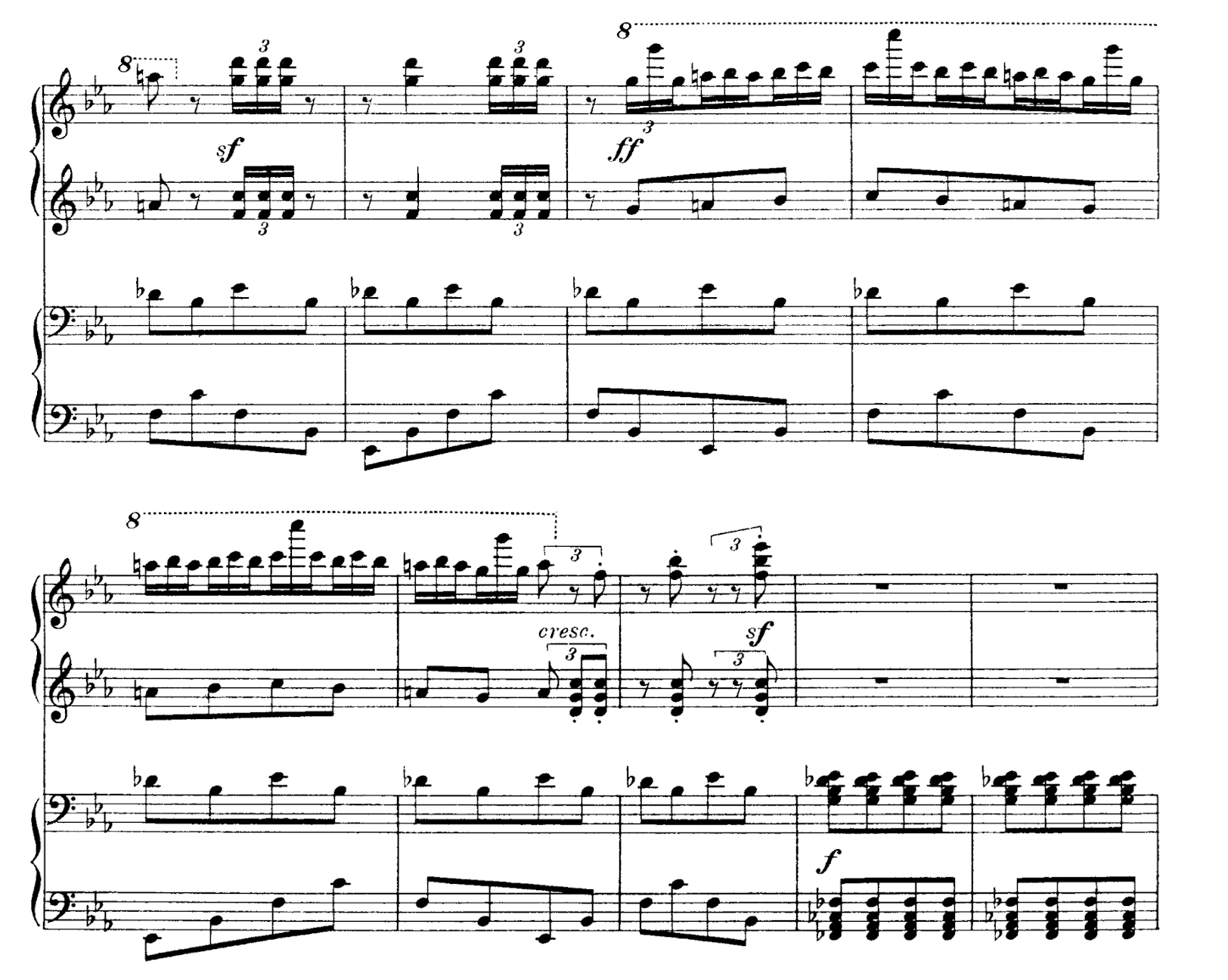
This fragment of the two-piano-reduction The Rite of Spring by Stravinsky[3] (between rehearsal numbers 16 and 18 of the orchestral version) mixes different harmonic systems in layers. The chords in bars 1-2 and 7-8 of the image are